

Bitcoin Art
A guide to the artists, works & ideas.
The Timechain guide to bitcoin art
Bitcoin art is artwork inspired by Bitcoin, its history, and the ideas surrounding it. Explore paintings, prints, sculpture, and crafted objects that give form to questions of money, freedom, time, and sovereignty.
Founded by artist Asanoha, Timechain Art Magazine documents Bitcoin art through its print publication, artist profiles, interviews and essays. Our growing archive includes more than 80 artists, with a particular focus on physical Bitcoin art and the people creating it.
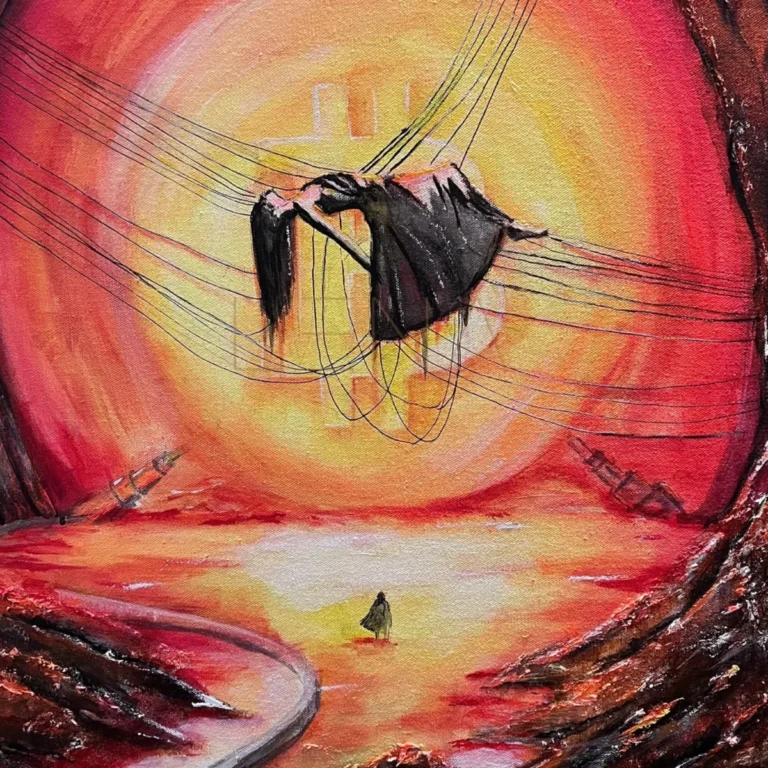
From the Timechain Artist Directory
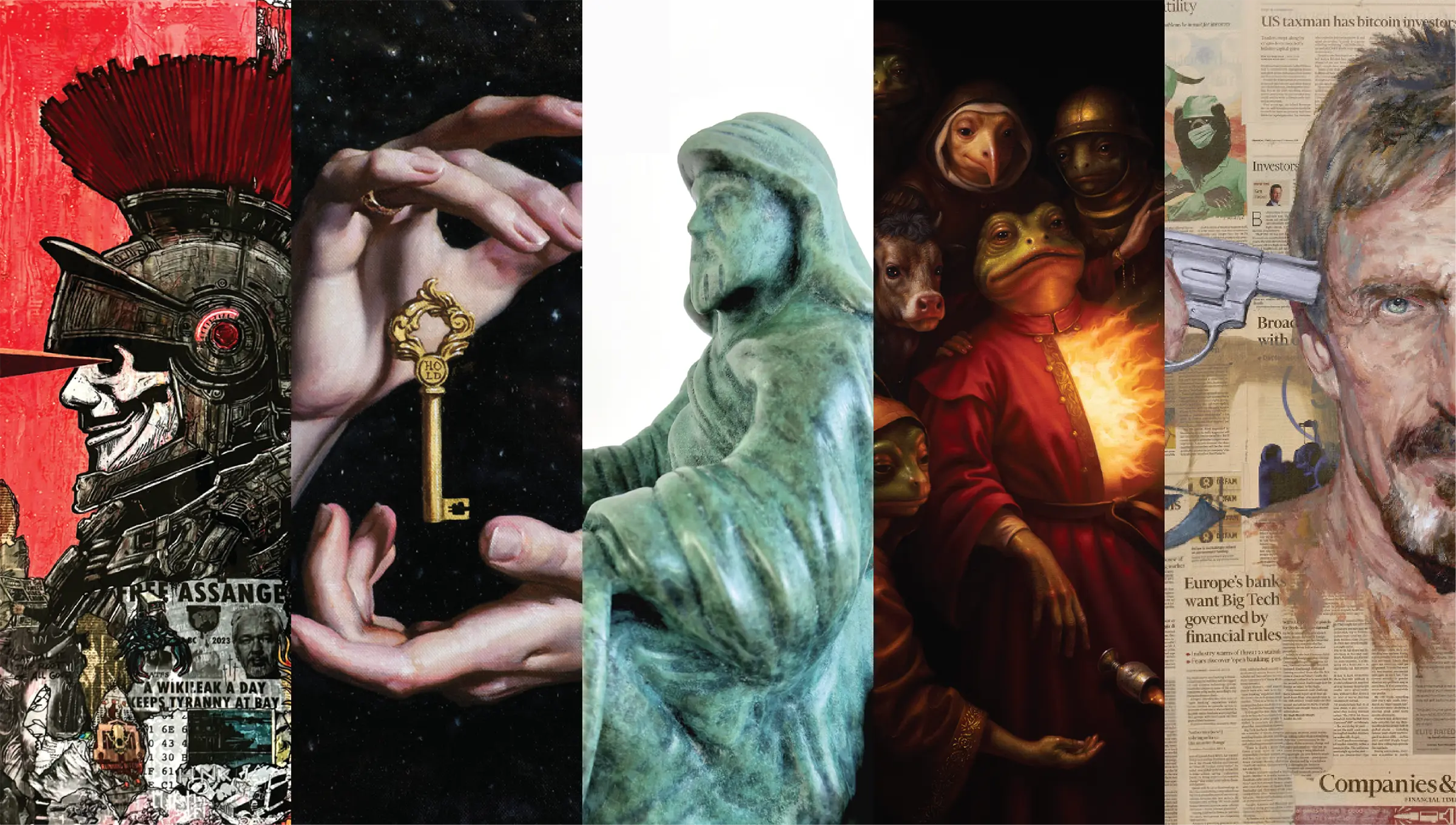
Understanding the movement
What is Bitcoin art?
A digital monetary system can inspire a painting, a carved stone, a public mural, or a carefully made book.
Bitcoin art connects artistic practice with Bitcoin’s technology, history, symbols, and social implications. Its subjects range from Satoshi Nakamoto and the Bitcoin symbol to privacy, personal autonomy, monetary policy, and the passage of time. Some works communicate an explicit message. Others approach these ideas through materials, composition, humor, or the process of making.
The term describes a field of interest rather than one visual style. A meticulously engraved panel and an expressive street mural can belong to the same conversation while looking entirely different. The useful questions are what a work explores, how the artist makes it, and how its relationship to Bitcoin is expressed.
Timechain’s focus is on paintings, prints, sculpture, functional objects, and hand-finished works. This guide introduces that material side of the movement and connects it to the artists, essays, and conversations in our archive.
Why Bitcoin inspires artists
Money shapes decisions about work, independence, and the future. Art gives those questions a form that people can encounter, question, and live with. A familiar object can become unfamiliar when an artist changes its material or context; an abstract argument can become personal through a portrait or a story.
For some artists, Bitcoin also informs the conditions of making: the time given to a piece, the durability of its materials, or the freedom to pursue a practice. Brekkie’s account of stone carving offers one artist’s perspective on this relationship between an idea and a working life.
Discover the directory
Bitcoin artists to explore
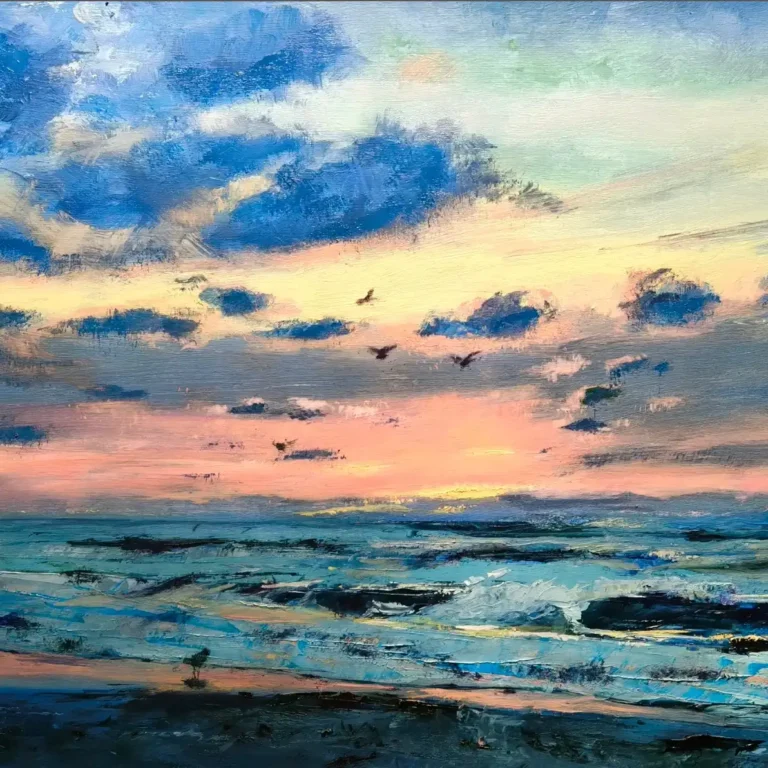
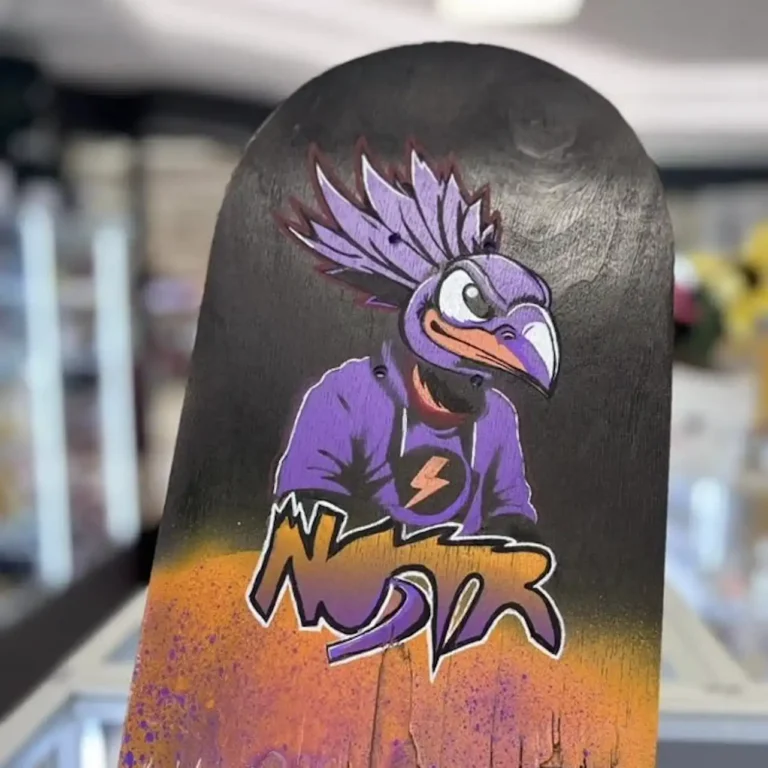
A random selection of twelve artists from our directory. Follow a profile to explore their practice.
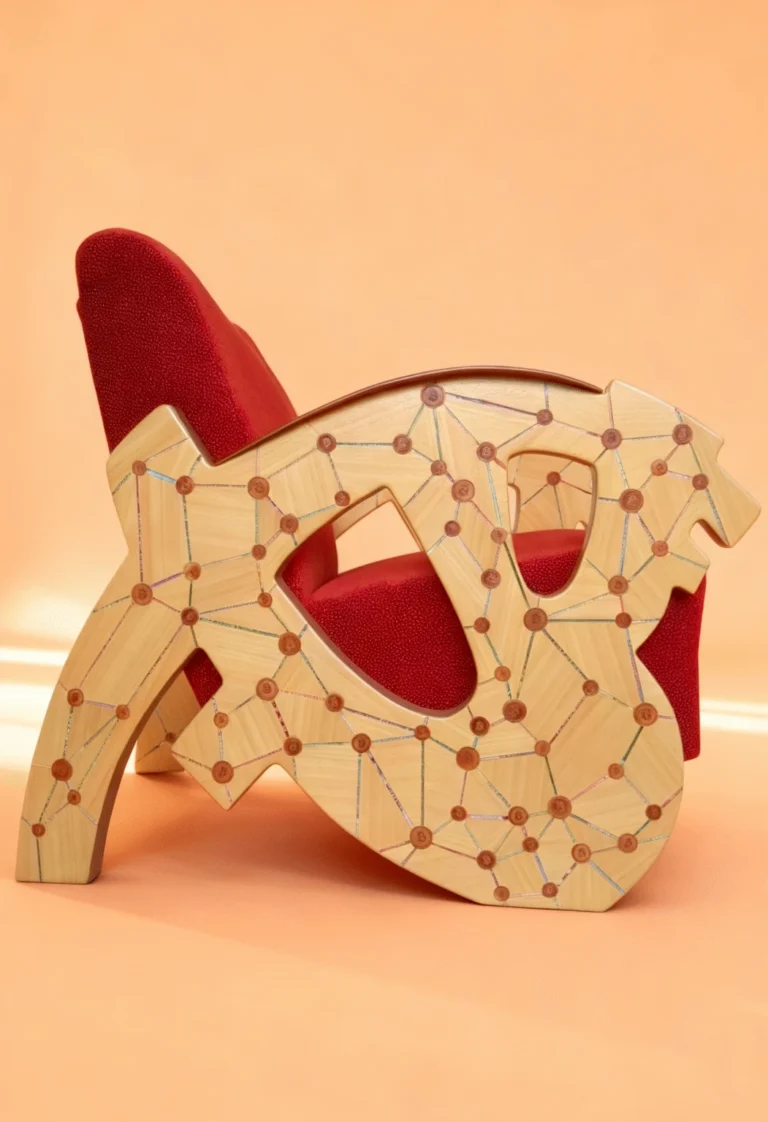
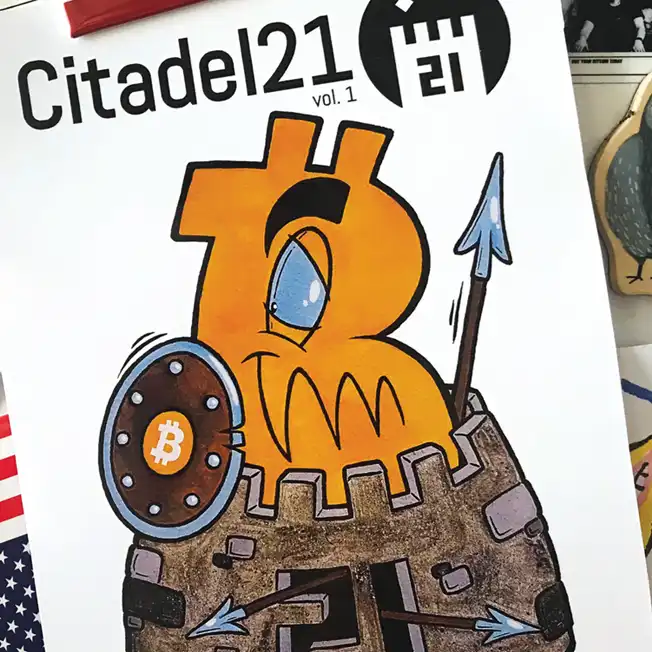
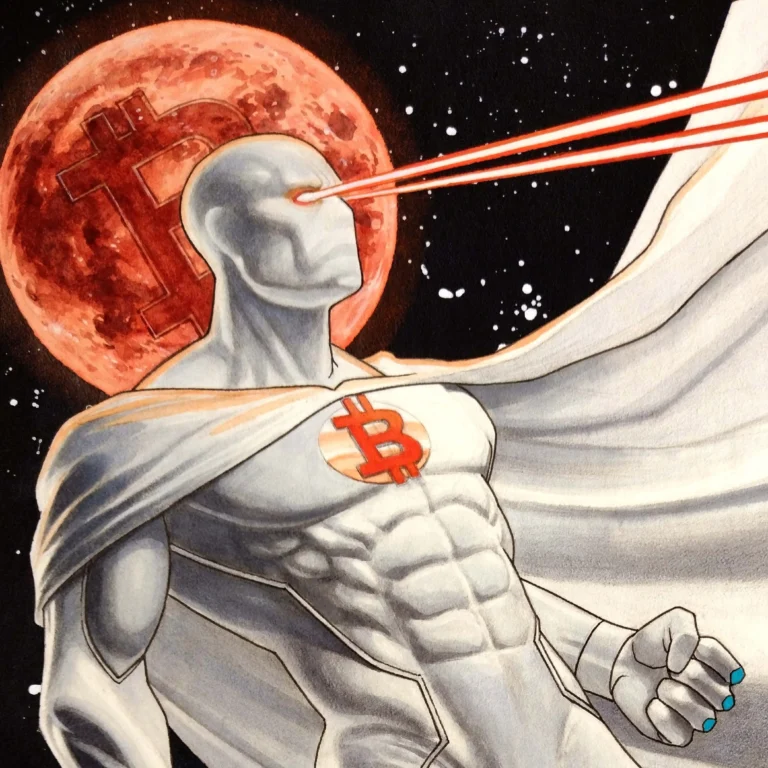
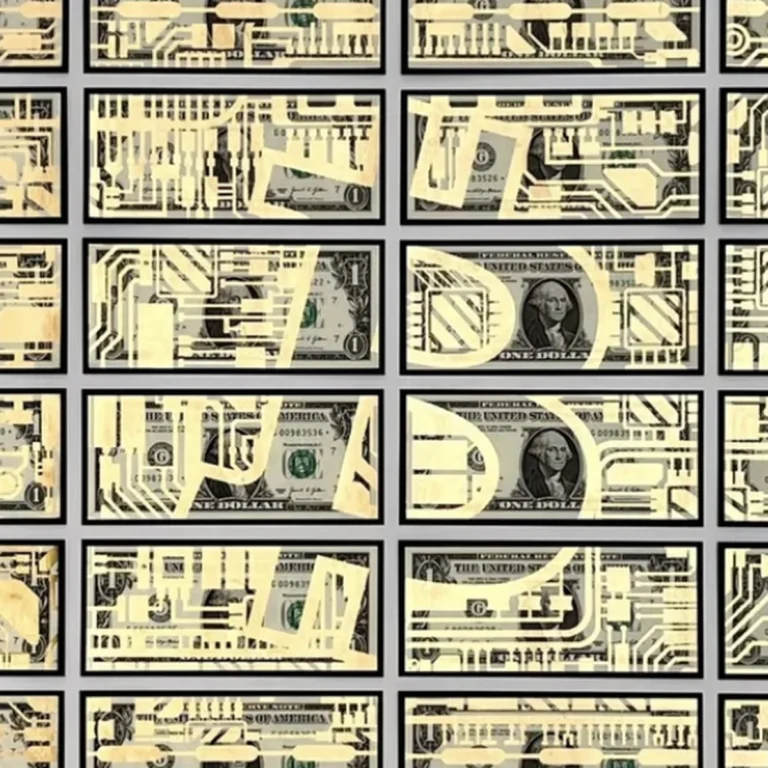
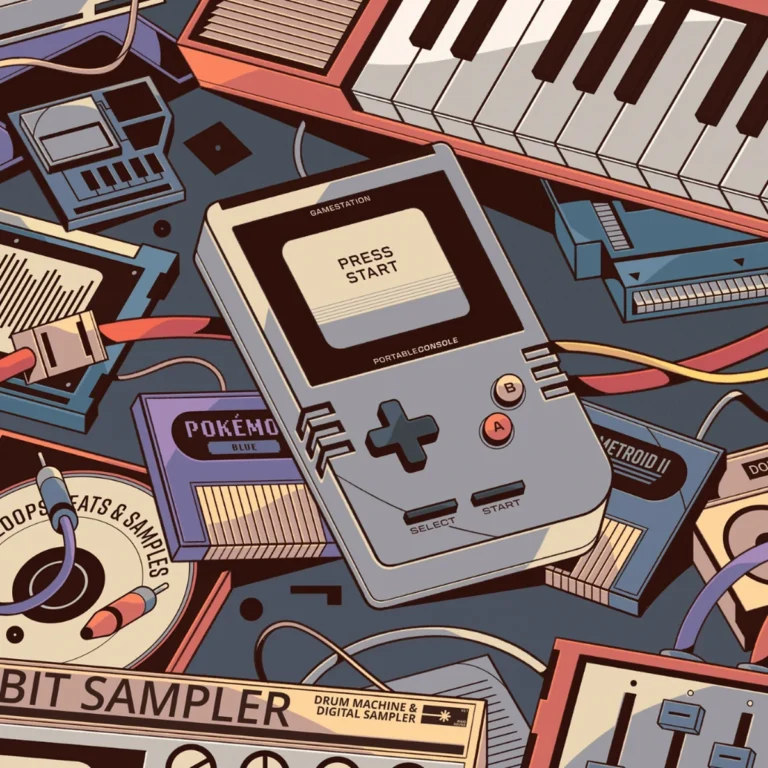
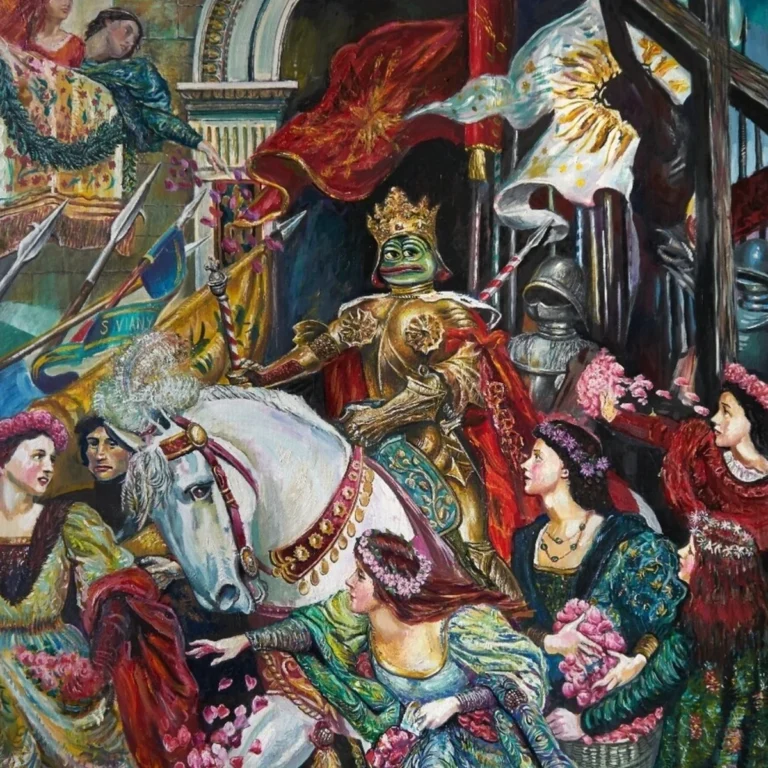
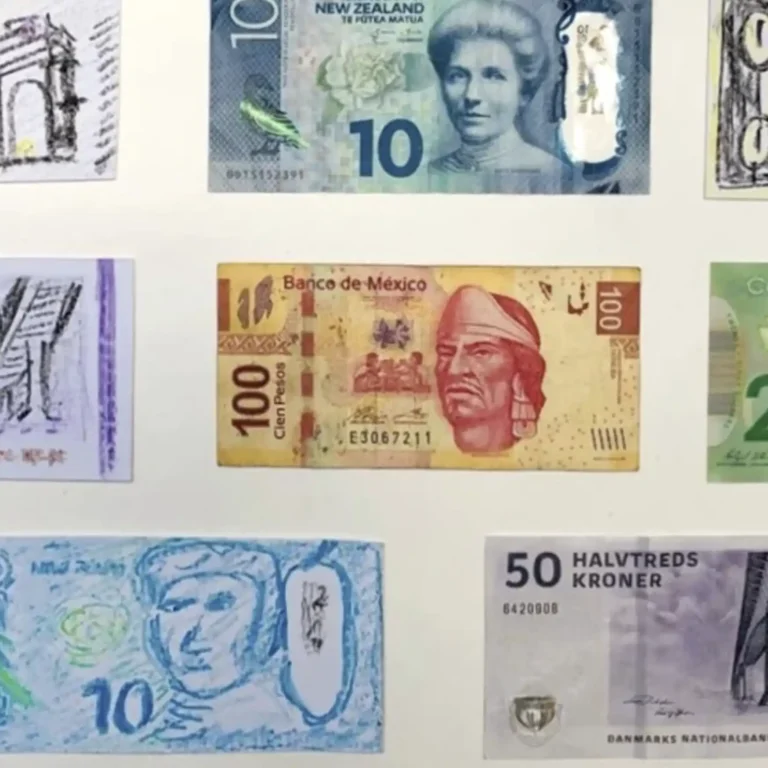
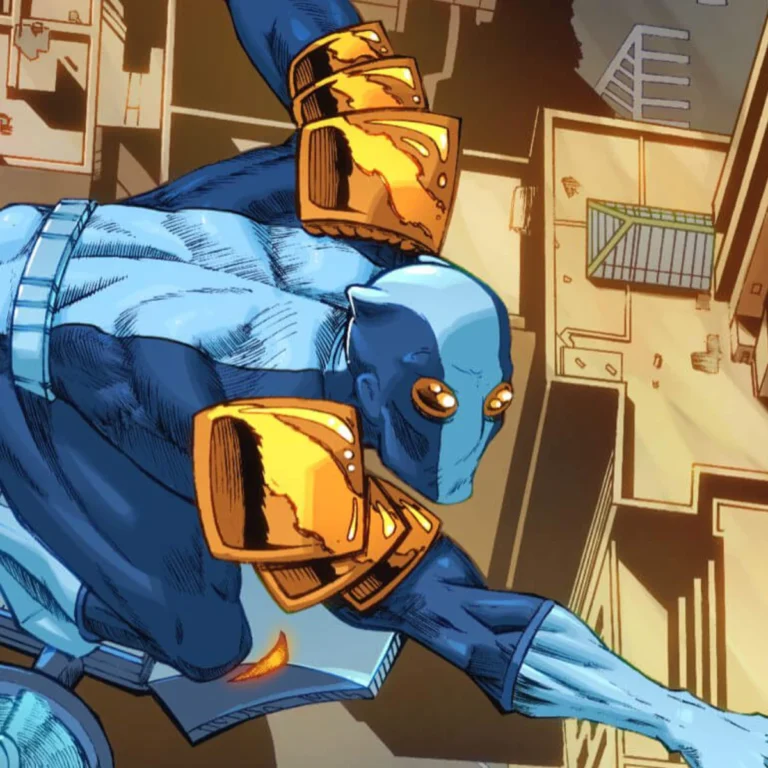
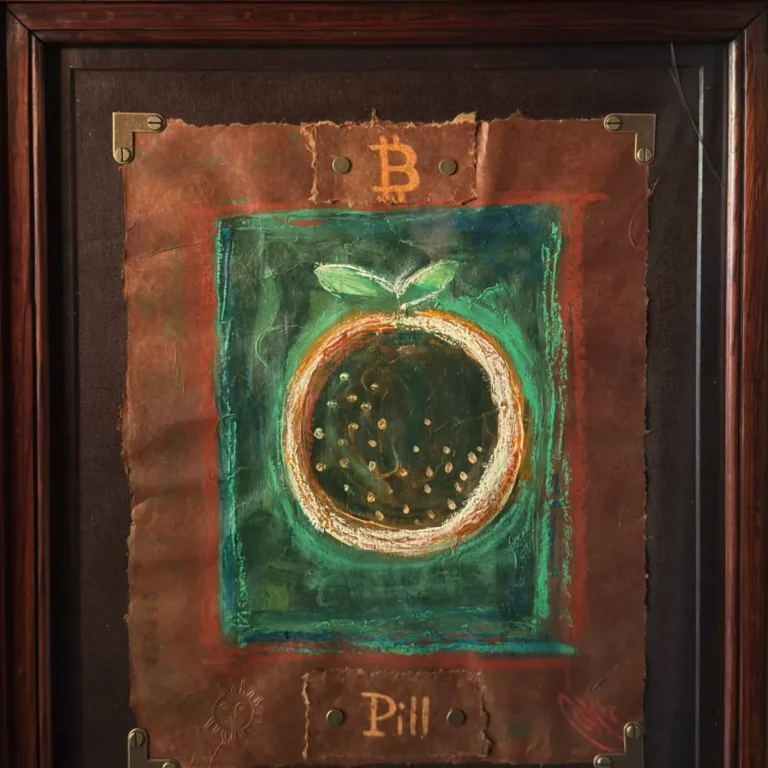
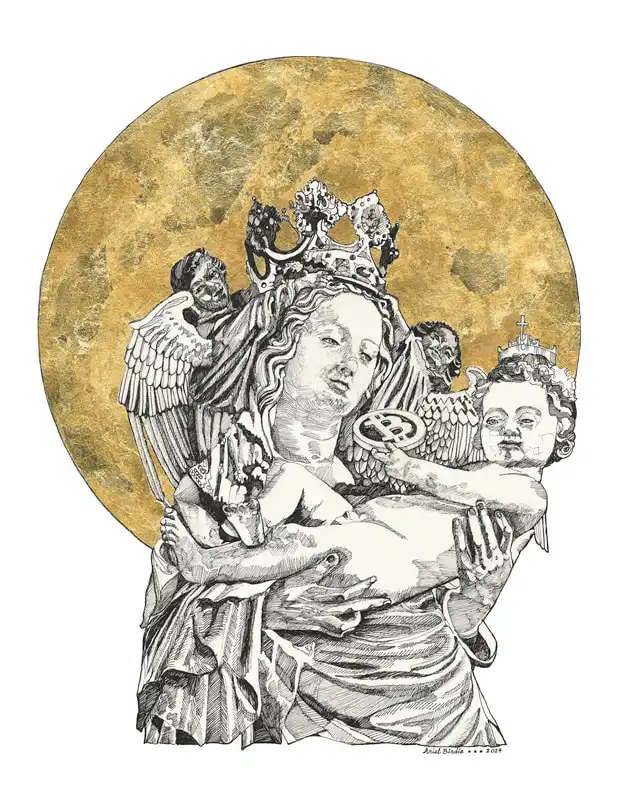
There is more to discover.
Browse the Bitcoin artist directory for more than 80 artist profiles, including established names and emerging creators.
Looking at the work
Physical Bitcoin Art: Paintings, Prints, Sculpture & Craft
Physical Bitcoin art takes many forms. Paint, paper, stone, metal, wood and other materials give Bitcoin’s ideas a tangible presence, while the methods used to make a work often become part of its meaning.
Paintings & murals
Bitcoin paintings range from portraits and historical scenes to abstraction, satire and imagined futures. Brushwork, composition, scale and surface all shape how the work is experienced. A mural made for a public wall has a different relationship with its audience from a painting intended for a private collection, even when both explore similar ideas.
Prints & editions
Bitcoin art prints can include screen prints, etchings, relief prints, archival reproductions and works combining printing with hand-applied details. The process matters. Paper, ink, dimensions, edition size, artist proofs, signatures and any work added by hand help describe what a collector is actually looking at. A limited edition refers to the number released, not to one particular printing method.
Sculpture & objects
Bitcoin sculpture brings weight, texture and physical scale to ideas that often begin in a digital or monetary context. Artists work in stone, bronze, wood, metal and found materials, including objects taken from banking and financial systems. In these works, the history of the material can be as important as the form the artist gives it.
Craft & functional works
Engraving, gilding, inlay, ceramics, woodworking and furniture extend Bitcoin art into forms associated with traditional craft and functional objects. Construction, finishing and small variations left by hand reveal how the work was made. Some pieces also bring Bitcoin-related ideas into objects that are handled, used or lived with rather than viewed only on a wall.
Recurring ideas
What Bitcoin art explores
Shared questions connect the field. Each artist answers in their own way.
Money & power
Banknotes, institutional symbols, and familiar financial objects can become material for examining who issues money, who controls it, and whose interests it serves. Reworking these objects invites viewers to reconsider the authority they normally carry.
Time & work
Repetition, patient craft, and durable materials can give form to ideas of accumulated effort and long-term thinking. When artists describe making as “proof of work,” they are using a cultural analogy; the labor of making an artwork is distinct from Bitcoin’s mining mechanism.
Freedom & memory
Privacy, self-determination, and resistance to censorship appear alongside portraits, tributes, and records of shared events. An artwork can preserve how people understood Bitcoin at a particular moment, including their hopes, disagreements, and sense of possibility.
A useful way to read any work: begin with what you can see, learn how it was made, and then consider the ideas the artist brings to it.
A visual vocabulary
Reading the symbols in Bitcoin art
Useful starting points for interpretation. A symbol’s meaning depends on the work and the artist’s intent.
- The Bitcoin symbol
- The recognizable letterform can make the subject immediately legible. Look at what contains it, what it is made from, and what surrounds it. Those choices determine whether it functions as a subject, a pattern, a marker of identity, or a point of tension.
- Numbers & scarcity
- The number 21 can refer to Bitcoin’s supply limit of 21 million. In an artwork or edition, ask whether the artist intends that connection. An edition number describes the release; it does not establish the artistic quality of the work.
- Satoshi & identity
- The name Satoshi Nakamoto opens questions about authorship, anonymity, and recognition. A symbolic portrait can explore those questions without identifying the person or people behind the pseudonym. Read the artist’s account before treating a face as a historical claim.
- Keys & access
- A key, lock, door, or enclosure offers a way to think about permission and control. The interpretation depends on who appears to hold access and what is being protected. cryptograffiti’s “Proof of Keys” provides a concrete material example.
- Clocks & blocks
- Dates, repeated units, and sequences can connect a work with the passage of time. FractalEncrypt’s functional sculptures explore Bitcoin through mechanisms representing block heights and longer periods. Here, time is something the work can also display.
- Reused money
- A banknote or banking object arrives with an earlier function and history. Cutting, assembling, painting, or repurposing it changes how it is encountered. Ask whether the work preserves, questions, or transforms the authority attached to that material.
Further context: Bitcoin’s monetary design · FractalEncrypt on time and sculpture
Selected milestones · 2011–2026
A history of Bitcoin art
From early installations and paintings to public monuments, international exhibitions, and dedicated publications, explore the artists and events that have shaped Bitcoin art.
Browse the timeline below. Open any entry for more detail and its sources.
Early experiments · 2011–2016
- 2011
BitcoinCloud brings mining into the gallery
BitcoinCloud was shown in the Art and Capital exhibition at Vienna's Künstlerhaus.
Details & sourcesClose details: BitcoinCloud brings mining into the gallery
- 2013
Marcus Connor creates Bitcoin Roller Coaster Guy
Connor created Bitcoin Roller Coaster Guy in early 2013 and shared the character through his own website and Bitcoin communities.
Details & sourcesClose details: Marcus Connor creates Bitcoin Roller Coaster Guy
- 2013
Street art meets Bitcoin
Beginning in 2013, cryptograffiti placed work in public and attached ways for viewers to send bitcoin.
Details & sourcesClose details: Street art meets Bitcoin
- 2013 August
Peter Fröhlich frames a working Bitcoin miner
Fröhlich presented a working mining computer as a wall-mounted artwork.
Details & sourcesClose details: Peter Fröhlich frames a working Bitcoin miner
- 2013 Late
Kuno Goda creates 200 Bitcoins
Goda's 200 Bitcoins reinterpreted the repeated currency imagery of Andy Warhol's 200 One Dollar Bills.
Details & sourcesClose details: Kuno Goda creates 200 Bitcoins
- 2014 February
Computers and Capital in Vancouver
This exhibition brought artistic responses to digital currency into a shared public setting.
Details & sourcesClose details: Computers and Capital in Vancouver
- 2014 6 march
The Bitcoin Art Fair at 20Mission
San Francisco's 20Mission hosted a Bitcoin art fair featuring fourteen artists.
Details & sourcesClose details: The Bitcoin Art Fair at 20Mission
- 2014
Youl paints Bitcoin Last Supper
Youl reimagined the Last Supper through Bitcoin imagery in a 140 × 70 cm painting commissioned through Project Bitcoin.
Details & sourcesClose details: Youl paints Bitcoin Last Supper
- 2014
cryptograffiti creates Nakamoto
Following the controversy surrounding Dorian Nakamoto's identification as Bitcoin's creator, cryptograffiti made a portrait from discarded credit cards.
Details & sourcesClose details: cryptograffiti creates Nakamoto
- 2014
Kialara introduces sculptural Bitcoin storage
Kialara debuted in 2014 with carefully constructed physical objects combining ornamental design, layered materials, and Bitcoin storage.
Details & sourcesClose details: Kialara introduces sculptural Bitcoin storage
- 2015
TORCHED H34R7S turns a painting into a puzzle
The painting encoded information that could reveal a Bitcoin private key.
Details & sourcesClose details: TORCHED H34R7S turns a painting into a puzzle
- 2016 25 may
Proof of Art brings artists together
Proof of Art brought together artists and makers working with Bitcoin, including coin_artist, Cryptoart's Troy Fearnow, Kialara's Max Mellenbruch, and Julia Tourianski.
Details & sourcesClose details: Proof of Art brings artists together
- 2014–2016
Counterparty art and Rare Pepes
Counterparty provided infrastructure for early artistic experiments associated with Bitcoin from 2014 onward.
Details & sourcesClose details: Counterparty art and Rare Pepes
A growing public presence · 2017–2018
- 2017
Imagining Bitcoin as banknotes
Matthias Dörfelt creates “Block Bills,” a series of 64 banknote images generated from Bitcoin block data. Colorful patterns and imagined portraits translate a digital monetary system into the familiar visual language of paper money.
Details & sourcesClose details: Imagining Bitcoin as banknotes
- 2018
A full-time artistic practice
Lucho Poletti leaves his corporate career to focus on Bitcoin-related art. His practice becomes one example of an artist building a sustained body of work around monetary ideas.
Details & sourcesClose details: A full-time artistic practice
- 2018 13 march
Kranj unveils a public Bitcoin monument
A large circular Bitcoin monument was unveiled in a roundabout in Kranj.
Details & sourcesClose details: Kranj unveils a public Bitcoin monument
- 2018 23–25 march
Andy Bauch exhibits New Money
Bauch exhibited colorful mosaics whose patterns encoded access to digital currency, including bitcoin.
Details & sourcesClose details: Andy Bauch exhibits New Money
- 2018
Trevor Jones paints The Ecstasy
Jones's 2018 collection included The Ecstasy, the original painting behind his Bitcoin Angel imagery.
Details & sourcesClose details: Trevor Jones paints The Ecstasy
- 2018 28 september–5 october
Bitcoin Art (r)evolution opens in Paris
Bitcoin Art (r)evolution assembled artists including Youl, coin_artist, Josie Bellini, and Andy Bauch.
Details & sourcesClose details: Bitcoin Art (r)evolution opens in Paris
- 2018 October
Nelson Saiers places a Bitcoin Rat outside the Fed
Saiers installed a roughly nine-foot inflatable rat covered in Bitcoin-related imagery outside the New York Federal Reserve.
Details & sourcesClose details: Nelson Saiers places a Bitcoin Rat outside the Fed
- 2018 December
Black Swan experiments with a microscopic art payment
Black Swan was offered through an auction in which the lowest bidder won.
Details & sourcesClose details: Black Swan experiments with a microscopic art payment
Exhibitions, sculpture, and collecting · 2019–2022
- 2019 January
Pascal Boyart paints Liberty Leading the People 2019
Boyart reworked Delacroix's Liberty Leading the People through the imagery of the Yellow Vest protests.
Details & sourcesClose details: Pascal Boyart paints Liberty Leading the People 2019
- 2019
AirdropVenezuela combines a mural with participatory aid
The artist assembled a portrait of Nicolás Maduro using one thousand bolívar banknotes.
Details & sourcesClose details: AirdropVenezuela combines a mural with participatory aid
- 2019
The Bitcoin Conference establishes a recurring art gallery
The Bitcoin Conference's art program traces its beginnings to the 2019 San Francisco event.
Details & sourcesClose details: The Bitcoin Conference establishes a recurring art gallery
- 2019–2020
Portraits of a Mind reaches Christie’s
Portraits of a Mind transformed Bitcoin's source code into a series of forty large circular paintings.
Details & sourcesClose details: Portraits of a Mind reaches Christie’s
- 2020
FractalEncrypt introduces the Full Node sculptures
FractalEncrypt's Full Node works translated Bitcoin's timing, mathematics, and issuance schedule into intricate physical objects.
Details & sourcesClose details: FractalEncrypt introduces the Full Node sculptures
- 2020
Scarce City builds a Bitcoin art marketplace
Founded in 2020, Scarce City developed a marketplace and auction system where artists and collectors could trade using bitcoin.
Details & sourcesClose details: Scarce City builds a Bitcoin art marketplace
- 2021
Asanoha creates his first Bitcoin artworks
Asanoha creates his first Bitcoin artworks, Guy Satoshi Daiji and Satoshi Rx Daiji. The following year, he exhibits and sells both works at the Bitcoin 2022 conference in Miami.
Details & sourcesClose details: Asanoha creates his first Bitcoin artworks
- 2021
BTC vs FED takes Bitcoin art onto twelve billboards
BTC vs FED placed twelve billboards in cities associated with Federal Reserve banks.
Details & sourcesClose details: BTC vs FED takes Bitcoin art onto twelve billboards
- 2021 5 june
Full Node Sculpture 7.0 records a 15.1 BTC winning bid
The auction record for Bitcoin Full Node Sculpture 7.0 shows a winning bid of 15.1 BTC from Mimesis Capital on 5 June 2021.
Details & sourcesClose details: Full Node Sculpture 7.0 records a 15.1 BTC winning bid
- 2021 16 september
Budapest unveils its Satoshi Nakamoto statue
A hooded sculpture representing Satoshi Nakamoto was unveiled in Budapest.
Details & sourcesClose details: Budapest unveils its Satoshi Nakamoto statue
- 2022 6 april
The Miami Bull debuts at Bitcoin 2022
The Miami Bull debuted during Bitcoin 2022.
Details & sourcesClose details: The Miami Bull debuts at Bitcoin 2022
- 2022
Bitcoin enters the furniture
Bitchair begins its project after years of chair restoration and woodworking, extending Bitcoin’s visual language into furniture and functional sculpture.
Details & sourcesClose details: Bitcoin enters the furniture
New work and lasting institutions · 2023–2026
- 2023
Ordinals opens a new chapter in Bitcoin digital art
The early-2023 launch introduced a widely adopted way of associating inscriptions with individual satoshis.
Details & sourcesClose details: Ordinals opens a new chapter in Bitcoin digital art
- 2023 March
Benjamin Von Wong creates Skull of Satoshi
Von Wong created a large skull sculpture using electronic waste and other industrial imagery.
Details & sourcesClose details: Benjamin Von Wong creates Skull of Satoshi
- 2024
The idea for a Bitcoin art magazine takes shape
After seeing an art gallery catalogue by Rebel Money, MLO, and Petek, Asanoha is inspired to create a magazine dedicated to Bitcoin art.
Details & sourcesClose details: The idea for a Bitcoin art magazine takes shape
- 2024 March
Bitcoin Atlantis presents Bitcoin art in Madeira
Bitcoin Atlantis included physical artworks in its conference setting.
Details & sourcesClose details: Bitcoin Atlantis presents Bitcoin art in Madeira
- 2024 April
The Finney Freedom Prize commissions Liberty
The Human Rights Foundation launched the Finney Freedom Prize to recognize contributions to Bitcoin's role in advancing freedom.
Details & sourcesClose details: The Finney Freedom Prize commissions Liberty
- 2024
BORDERLESS rotates across the US–Mexico border
BORDERLESS arranged twelve Bitcoin recovery words around a rotating structure mounted at the US–Mexico border.
Details & sourcesClose details: BORDERLESS rotates across the US–Mexico border
- 2024 October
Lugano unveils a disappearing Satoshi
A sculpture of Satoshi Nakamoto was unveiled during Lugano's Plan B Forum.
Details & sourcesClose details: Lugano unveils a disappearing Satoshi
- 2025 May
The Art of Freedom expands the conference gallery
The Art of Freedom expanded the Bitcoin Conference's gallery presentation in Las Vegas.
Details & sourcesClose details: The Art of Freedom expands the conference gallery
- 2025
Bitcoin art finds a dedicated publication
Asanoha founds Bitcoin Art Magazine, now Timechain Art Magazine, and launches its Genesis Edition, bringing Bitcoin art and artists together in print.
Details & sourcesClose details: Bitcoin art finds a dedicated publication
- 2025 December
A Satoshi sculpture is unveiled at the NYSE
Another work in Picozzi's disappearing Satoshi series was installed at the New York Stock Exchange, with the exchange publicly announcing it on 10 December.
Details & sourcesClose details: A Satoshi sculpture is unveiled at the NYSE
- 2026 3 january
Bitcoin Museum & Art Gallery opens in Nashville
BMAG lists 3 January 2026 as its opening date.
Details & sourcesClose details: Bitcoin Museum & Art Gallery opens in Nashville
- 2026
BTC Prague announces Building Bridges
BTC Prague's 2026 program announced Building Bridges, directed by FractalEncrypt and bringing together an international group of artists.
Details & sourcesClose details: BTC Prague announces Building Bridges
This timeline brings together documented works, exhibitions, and milestones in a history with many contributors. Dates refer to the creation, exhibition, sale, or announcement described in each entry. Paintings, public works, prints, sculpture, and digital art continue to develop alongside the people and ideas surrounding Bitcoin.
A collector’s starting point
How to choose Bitcoin art
Start with the work you want to spend time with. Then learn about the artist, the materials, and the particular object or edition you are considering.
Artist websites, galleries, exhibitions, and specialist publications can help you discover work. Our directory offers a route into artists’ practices; availability and purchase terms should be confirmed with the artist or seller.
Understand what the object is.
Confirm whether it is a unique original, an editioned print, a reproduction, or a work with hand-applied additions. Ask for the medium, support, dimensions, and clear photographs of the actual piece.
Read the edition information.
For an edition, confirm the number of copies, whether there are artist’s proofs or other variants, and how each copy is signed or numbered. The word “limited” is useful only when the limits are explained.
Keep the artwork’s record.
Retain the invoice, title, artist’s name, date, edition details, and any certificate supplied. Provenance is the history of an artwork’s ownership. A certificate is one part of the documentation, and its issuer matters.
Consider display and care.
Ask about framing, mounting, light exposure, cleaning, and transport. A work on paper, a lacquered panel, and a heavy sculpture have different needs. Get care instructions for the materials in the piece you choose.
Let artistic interest lead.
Consider the quality of the work, its connection to the artist’s wider practice, and what it means to you. A small edition or a Bitcoin theme does not guarantee future resale value.
Edition terms worth understanding
What a description tells you, and what to ask next
- Original print
- A work conceived through a printmaking process. Confirm the process and edition details; an original print can exist in multiple impressions.
- Reproduction
- A printed version of an existing work. Confirm the source work, printing process, support, dimensions, and any edition limit.
- Artist’s proof / AP
- An impression designated as an artist’s proof, usually outside the numbered edition. Ask how many proofs exist alongside it.
- Hand-finished
- Some work has been applied by hand. Ask what was added, how much varies between copies, and how the underlying image was produced.
- Certificate of authenticity
- A document identifying and attesting to a work. Check who issued it and whether its title, medium, dimensions, and edition details match the object.
From the Timechain archive
Hear from the artists
Essays and conversations that take the guide into the studio.
Carving Bitcoin in Stone
A sculptor’s account of patience, material, and the relationship between making and proof of work.
Read the essayBeginning with the clay
Antonio Batzu joins Yonat Vaks to discuss finding natural clay and working with material gathered from the landscape.
Watch the conversationArt, time & the making process
A conversation with Yonat Vaks about materials, time, process, and meaning in Bitcoin-related art.
Watch the conversationWhere to experience Bitcoin art
Look for artist exhibitions, studio visits, specialist galleries, and art programs within Bitcoin events. In person, notice the actual scale, surface, and construction. Ask which features are difficult to see in a photograph and how the work was intended to be displayed.
BTC Prague’s “Building Bridges” curator interview offers a documented example of an art program within a conference. For future visits, confirm dates, venue access, and participating artists with the organizer. Exhibition schedules change; an archived report is a record of a particular event.
From the studio
Making the work. Sharing the story.
If Bitcoin informs your practice, help viewers understand the connection. A clear record of the work gives editors, curators, and collectors something concrete to explore.
Start with a question that matters to you.
What aspect of Bitcoin interests you: control, time, work, memory, or exchange? Let that question shape the material and composition. Explain the relationship in your own words.
Show how the work is made.
Photograph the finished object, its details, and its scale. Keep a record of experiments and studio stages. Explain digital, printed, and hand-applied elements accurately.
Make the details easy to find.
Record the title, year, medium, support, dimensions, and edition information. Include image credits and a short artist statement. Give each finished work a stable page in your portfolio.
Share a focused introduction.
Send a short biography, a portfolio link, and a few representative works with complete captions. Describe the connection to Bitcoin and the question you want the work to open. A submission is an invitation to editorial consideration.
Common questions
Bitcoin art, explained.
What makes a work Bitcoin art?
A meaningful connection to Bitcoin’s ideas, history, technology, or culture. That connection can appear in its subject, materials, process, or the artist’s stated intention. It does not require one style or a visible Bitcoin symbol.
Can Bitcoin art be a painting or a sculpture?
Yes. Paintings, prints, murals, stone carving, bronze sculpture, furniture, and hand-finished objects all appear in the field. Bitcoin can be the subject or inspiration for an artwork made with traditional materials.
Is Bitcoin art always digital?
No. The wider term can include digital work, but many artists make objects using paint, paper, wood, stone, metal, and other materials. Timechain’s guide concentrates on these tangible works and the people who make them.
Where can I find Bitcoin artists?
Start with Timechain’s Bitcoin artist directory, which brings together more than 80 profiles. Explore a practice through its profile, then seek out the artist’s own statements, exhibitions, and available work.
Where can I buy Bitcoin art?
Explore artists’ own shops, galleries representing their work, and exhibitions with a clear sales contact. Check current availability with the seller. Timechain also has a shop featuring its publications and selected art releases.
Do I need bitcoin to collect Bitcoin art?
Payment options depend on the artist or seller. Some accept bitcoin, some accept conventional payments, and some offer both. Confirm the available methods, shipping arrangements, and purchase terms before ordering.
What is the difference between an original and a print?
An original painting or sculpture is an individual artwork. A print is produced through a printing process and may be an original editioned work or a reproduction of another work. Ask which description applies and whether any elements were added by hand.
Can a digitally designed image become a handmade work?
Yes. An artist might develop an image using digital tools, then print, paint, engrave, or otherwise work with it as an object. Describe the actual process clearly. A painted addition, a signature, and a wholly hand-painted composition are different kinds of work.
What affects the price of Bitcoin art?
Medium, size, edition, condition, provenance, the artist’s practice, and the seller’s terms can all matter. Compare like with like and ask what is included, such as framing and shipping. A theme or edition size alone does not establish a fair price or future value.
About this guide
Documenting the work.
Preserving the context.
Timechain Art Magazine is an independent art and culture publication founded by Asanoha. Our focus is the artwork and creative practices shaped by Bitcoin, with an emphasis on painting, printmaking, sculpture, and craft.
This guide connects artist profiles with published essays and conversations. The selections introduce different approaches; they are not a ranking of artists. Artwork titles and materials can be explored further through the linked profiles and artist sources.